
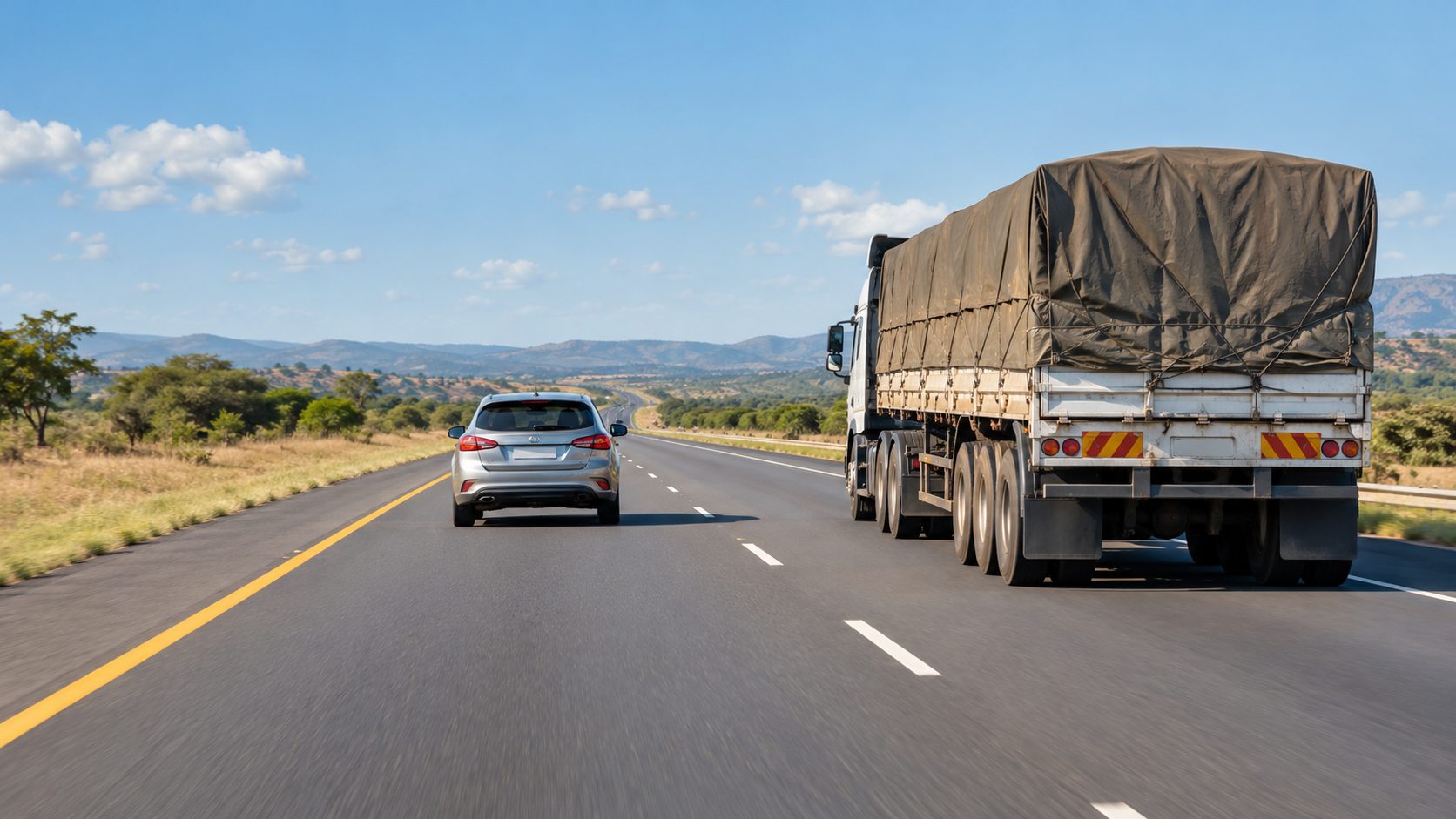
Passing a heavy truck is one of those moments when a few seconds can feel expensive. The safer decision is often to wait. This is a practical routine for any long drive where a car shares the road with freight vehicles; it is not a substitute for the road signs, speed limit and passing rules where you are driving.
Why give the moment extra respect? Large trucks and buses have bigger blind spots, need more room to turn and take longer to stop than passenger cars. The US Federal Motor Carrier Safety Administration (FMCSA) notes that a fully loaded truck can need up to the length of two football fields to stop in good conditions, so cutting back in too early removes precious space. FMCSA: Tips for Passenger Vehicle Drivers
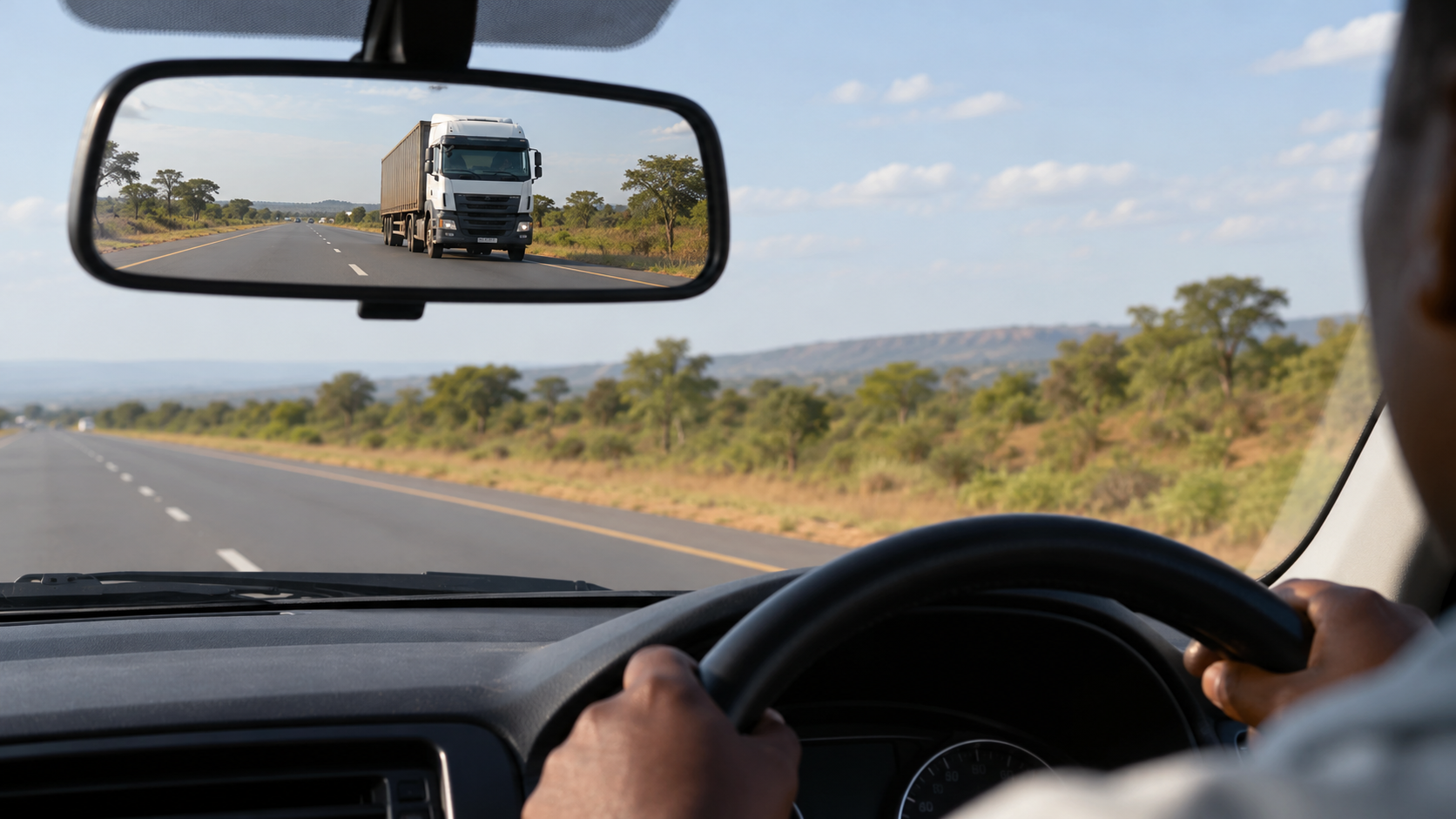
Use the mirror test before you move back in
Do not start a pass simply because the truck is moving slowly. First, make a deliberate no-pass check: obey the marked lane and local rules; do not pass into a bend, a crest, an intersection, a work zone or a closing gap; and do not use an emergency shoulder as a passing lane. If the road does not offer an obvious, comfortable margin, keep your position and wait.
- Leave a view, not a guess. Stay far enough back to see the road ahead before you decide. If you cannot see around the vehicle clearly, you do not have the information to commit.
- Signal early and pass without lingering beside the truck. Blind spots on a large vehicle can hide a passenger car. FMCSA’s useful rule of thumb is simple: if you cannot see the driver’s face in the truck’s mirror, assume the driver cannot see you. FMCSA guidance
- Keep your speed legal and controlled. Do not turn the pass into a race. WHO says higher average speed increases both crash likelihood and injury severity; its 2026 fact sheet estimates that a 1% increase in mean speed is associated with a 4% increase in fatal-crash risk. WHO road-traffic-injury fact sheet, July 2026
- Finish, then find the truck in your rear-view mirror. Once the complete front of the truck is visible in your mirror, signal and return smoothly, leaving space rather than braking sharply in front of it. FMCSA specifically advises drivers to ensure the truck is visible in the rear-view mirror before merging back ahead. FMCSA guidance
- Reset your following distance. After returning to your lane, keep moving at a safe, lawful pace. Do not immediately slow hard or stop in front of the truck, especially on an incline. Large vehicles need room to respond. FMCSA guidance
Give turns and gradients their own margin
A truck that looks as if it is drifting may be setting up for a wide turn. Do not try to slip between a turning truck and the kerb or another lane: large vehicles may first move outward to create room, then turn across space a car might mistake as available. FMCSA advises waiting for trucks and buses to complete wide turns. FMCSA guidance
On a descent, patience matters as well. Heavy vehicles can gain speed downhill, which is why FMCSA advises against passing them on hills or mountains. A sensible local rule is to wait for a long, clearly visible and legally permitted stretch of road rather than gambling on a short opening. FMCSA guidance
Make the safer choice early
Road safety is bigger than one driver’s technique. WHO reports that 92% of global road deaths occur in low- and middle-income countries, and it frames safer roads, speeds, vehicles and road users as parts of one safe-system approach. That is a useful reminder: a calm, declined pass is not lost time—it is a decision that preserves options for everyone sharing the road. WHO road-traffic-injury fact sheet, July 2026
Takeaway: pass only when the road, sight distance and local rules all say yes; move through the blind-spot area decisively; and use the rear-view-mirror test before returning ahead of a truck.
Sources
- Federal Motor Carrier Safety Administration — Tips for Passenger Vehicle Drivers (updated 29 September 2026)
- World Health Organization — Road traffic injuries (20 July 2026)
Cover image credit: original Vroom Africa editorial image, created with OpenAI. It depicts a safe following/pass scenario for illustration and is not a real-world road-safety instruction photograph.